
BMI and calorie calculators turn a few measurements into useful screening estimates. They can help with broad planning, but they cannot diagnose health, measure body composition directly, or account for every biological and lifestyle factor.
Use the numbers as starting points rather than precise targets. Trends in energy, performance, weight, sleep, and professional medical guidance provide context that a formula alone cannot supply.
What BMI measures
Body mass index divides weight in kilograms by height in metres squared. Adult category ranges provide a quick population-level screening measure. BMI does not distinguish muscle from fat or show where body fat is distributed.
Athletes, older adults, pregnant people, children, and people from different population groups may need more appropriate assessment. A category should never be treated as a diagnosis or a judgment about a person.
BMI = weight in kg / (height in metres x height in metres)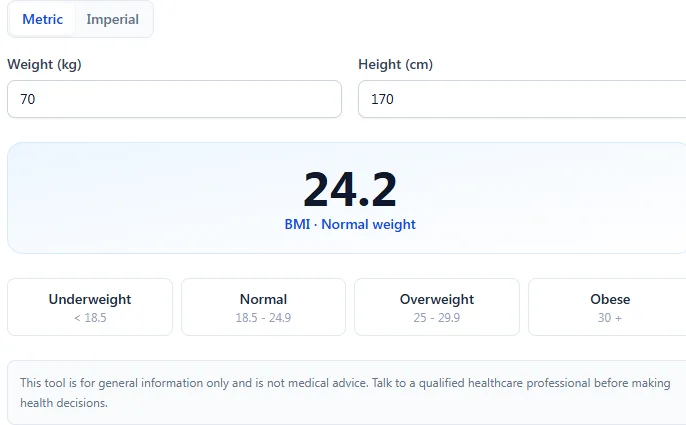
From BMR to daily calorie needs
Basal metabolic rate estimates the energy used for essential functions at rest. A calorie calculator multiplies BMR by an activity factor to estimate total daily energy expenditure, often called TDEE.
Activity labels are broad. Two people who both select moderate activity can have different jobs, exercise intensity, body composition, and recovery needs. Treat the output as an initial estimate and adjust using real trends over time.
- Choose an activity level based on a typical week, not the busiest day.
- Avoid reacting to one day of body-weight fluctuation.
- Make gradual changes rather than extreme calorie cuts.
- Recalculate when weight or activity changes meaningfully.
Interpret the estimate safely
Food labels, portion estimates, and wearable calorie readings also contain uncertainty. Chasing exact daily arithmetic can create false precision. A consistent routine and longer-term average are generally more informative than a single calculated target.
Use multiple signals
A responsible health plan considers more than weight. Energy, strength, cardiovascular fitness, sleep quality, blood pressure, laboratory results, and mental wellbeing can all matter. Use calculators to support questions and planning, not to replace professional assessment.
Try the related tools
Apply the steps from this guide directly in your browser.
Frequently asked questions
Is BMI an accurate body-fat measurement?
No. BMI uses only height and weight. It can be useful for screening but does not directly measure body fat or muscle mass.
Is a calorie calculator exact?
No. It estimates BMR and activity expenditure from population formulas. Individual needs can differ and change over time.
How often should I recalculate calorie needs?
Recalculate after a meaningful change in body weight, activity, or goals, rather than responding to normal daily fluctuations.