
Character count and word count both measure text length, but they answer different questions. Character count is useful when software enforces a fixed field size. Word count is better when an editor, teacher, or publisher wants a certain amount of written content.
Choosing the right metric prevents misleading comparisons. A short word and a long word each add one to the word count, but they contribute very different numbers of characters.
The basic difference
A character count measures individual letters, numbers, spaces, punctuation marks, and symbols. A word count measures groups of text separated by whitespace or punctuation rules. The exact treatment of hyphenated terms and contractions can vary between applications.
Consider 'Fast online tools'. It has three words and 17 characters including spaces. The two totals describe the same phrase from different perspectives.
When character count matters
Use character count for titles, search snippets, usernames, text messages, database fields, and social platforms. These systems store or display text within a limited space, so every letter and space can affect whether the text fits.
- SEO titles and descriptions
- Social media posts and advertisements
- Form fields, usernames, and profile biographies
- SMS messages and notification copy
When word count matters
Use word count for essays, articles, reports, speeches, and book manuscripts. It is a practical estimate of content depth and the effort needed to read or edit a document. It should not be treated as a quality score: a concise 700-word guide can be more useful than a repetitive 2,000-word article.
- Academic assignments and applications
- Editorial briefs and freelance contracts
- Reading-time estimates
- Translation and proofreading quotes
Use supporting metrics together
Sentence count can reveal whether a paragraph is becoming dense. Average word length and reading time help you judge accessibility. Line count matters for subtitles, scripts, addresses, and code. No single number describes writing quality, but several simple metrics can expose practical problems before publication.
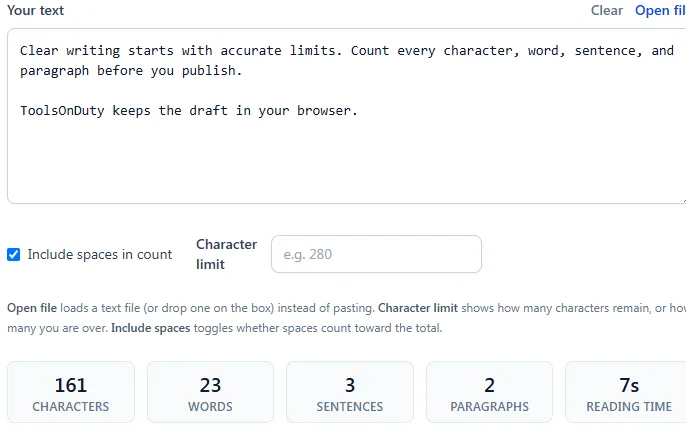
Start with the metric required by the destination, then use the others as editing signals. The ToolsOnDuty word counter reports the key measurements together so you do not have to move the text between several applications.
Try the related tools
Apply the steps from this guide directly in your browser.
Frequently asked questions
Is word count more important than character count?
Neither is universally more important. Use the metric specified by the platform, editor, school, or client receiving the text.
Do hyphenated words count as one or two words?
It depends on the counting rules used by the application. Many counters treat a connected hyphenated term as one word, while some editorial standards count its parts separately.
Can word count predict reading time?
It can provide an estimate. Reading-time tools divide the word total by an assumed reading speed, but complexity and formatting also affect the real time.