
Percentage problems often look similar while requiring different formulas. You may need a percentage of an amount, the percentage represented by one value, or the percentage change between an old and new value.
The most common mistake is choosing the wrong base. For a change, the original value is the base. For a discount, the original price is the base. Writing down what represents 100 percent prevents many errors.
Find a percentage of a number
Convert the percentage to a decimal and multiply by the amount. To find 15 percent of 80, calculate 0.15 times 80, which equals 12. This pattern is useful for tips, taxes, commissions, and portions of a total.
15% of 80 = (15 / 100) x 80 = 12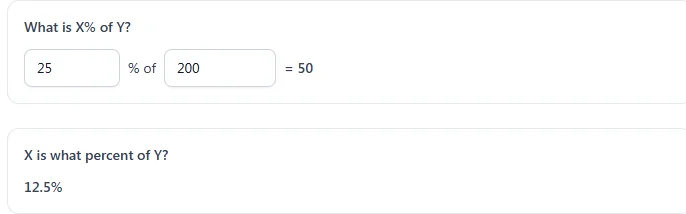
Find what percent one value is of another
Divide the part by the whole and multiply by 100. If 18 of 24 tasks are complete, 18 divided by 24 equals 0.75, so progress is 75 percent. The whole cannot be zero because division by zero is undefined.
Calculate percentage change
Subtract the old value from the new value, divide the difference by the old value, and multiply by 100. A negative result represents a decrease. Moving from 50 to 60 is a 20 percent increase because the change of 10 is measured against the original 50.
Reversing a percentage is not symmetric. A 20 percent increase from 50 reaches 60, but a 20 percent decrease from 60 reaches 48 because the second calculation uses a different base.
Handle discounts and final prices
Calculate the discount amount from the original price, then subtract it. A 25 percent discount on 200 is 50, so the final price is 150. Add tax afterward if the store applies tax to the discounted price.
Try the related tools
Apply the steps from this guide directly in your browser.
Frequently asked questions
How do I convert a percentage to a decimal?
Divide by 100. For example, 7.5 percent becomes 0.075.
Why is percentage change based on the old value?
The old value represents the starting 100 percent, so the difference is compared with that original baseline.
Can a percentage increase exceed 100 percent?
Yes. An increase from 20 to 50 is 150 percent because the gain of 30 is one and a half times the original 20.