
A loan payment depends on the amount borrowed, interest rate, repayment term, payment frequency, and fee structure. Looking only at the monthly payment can hide a much larger total cost created by a longer term.
Calculators are useful for comparing scenarios, but their output is an estimate. Real offers may include processing fees, insurance, taxes, changing rates, or rounding rules that are not part of a basic amortization formula.
Know the main inputs
Principal is the amount financed. The annual interest rate determines the cost charged on the outstanding balance. The term controls how many payments are made. A larger down payment reduces principal, while a longer term usually lowers the monthly amount and increases total interest.
- Principal: amount borrowed after any down payment.
- Rate: annual interest percentage used by the estimate.
- Term: total repayment period in months or years.
- Fees: additional costs that may not be included in EMI.
Understand EMI and amortization
For a standard fixed-rate amortizing loan, EMI is the regular payment designed to repay principal and interest by the end of the term. Early payments contain more interest because the outstanding balance is larger. Later payments direct more money toward principal.
An amortization schedule shows this split for each payment. It helps reveal how slowly the balance may fall during the early part of a long loan.
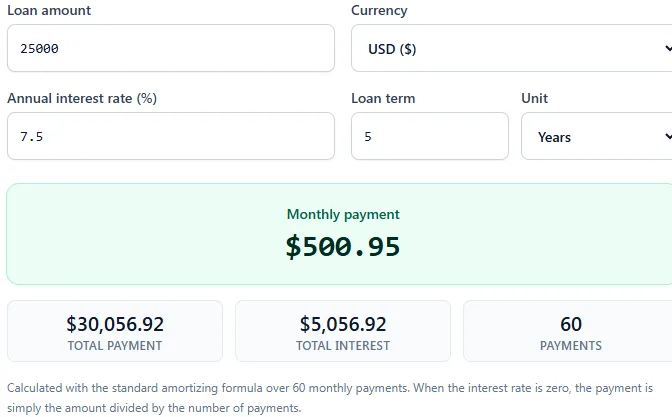
Compare total cost, not only EMI
A lender can reduce the displayed monthly payment by extending the term. Compare the total of all payments, effective annual rate, fees, prepayment rules, and whether the rate is fixed or variable.
Run more than one scenario. Test a shorter term, a larger down payment, and a slightly higher interest rate. This shows how sensitive the budget is to changing conditions.
Consider early payments carefully
Extra principal payments can reduce future interest and shorten the term, but some agreements limit prepayment or charge a fee. Verify how the lender applies extra money and whether it reduces principal immediately.
Try the related tools
Apply the steps from this guide directly in your browser.
Frequently asked questions
What is the difference between a loan payment and EMI?
EMI is an equal periodic payment for an amortizing loan. Loan payment is a broader term and can include structures with changing or irregular amounts.
Does a lower EMI always mean a cheaper loan?
No. A longer term can lower EMI while increasing total interest and the overall amount repaid.
Why is the interest portion higher at the beginning?
Interest is calculated on the outstanding balance, which is largest near the beginning of a standard amortizing loan.