
Time-zone conversion is not always a fixed addition or subtraction. Daylight saving rules change offsets during the year, countries revise those rules, and locations with the same abbreviation can represent different zones.
The safest workflow converts a specific date and time between named city zones. It then communicates the result with the date, city, and zone abbreviation so nobody has to infer which offset was intended.
Use a city zone instead of a fixed offset
A label such as UTC+1 describes an offset, not the full rules of a location. Europe/London and Europe/Berlin change offsets on seasonal schedules, while many regions do not observe daylight saving time at all. Named IANA zones allow software to apply the rules for the selected date.
Choose the city representing the participants rather than a familiar abbreviation. CST, for example, is ambiguous in international communication.
Include the date in every conversion
London and New York do not switch daylight saving time on the same dates. For part of the year, the usual difference between them temporarily changes. A conversion without a date can therefore be wrong for the meeting being planned.
The destination can also fall on the previous or next calendar day. Always display the date beside the time, especially for flights, deadlines, and events near midnight.
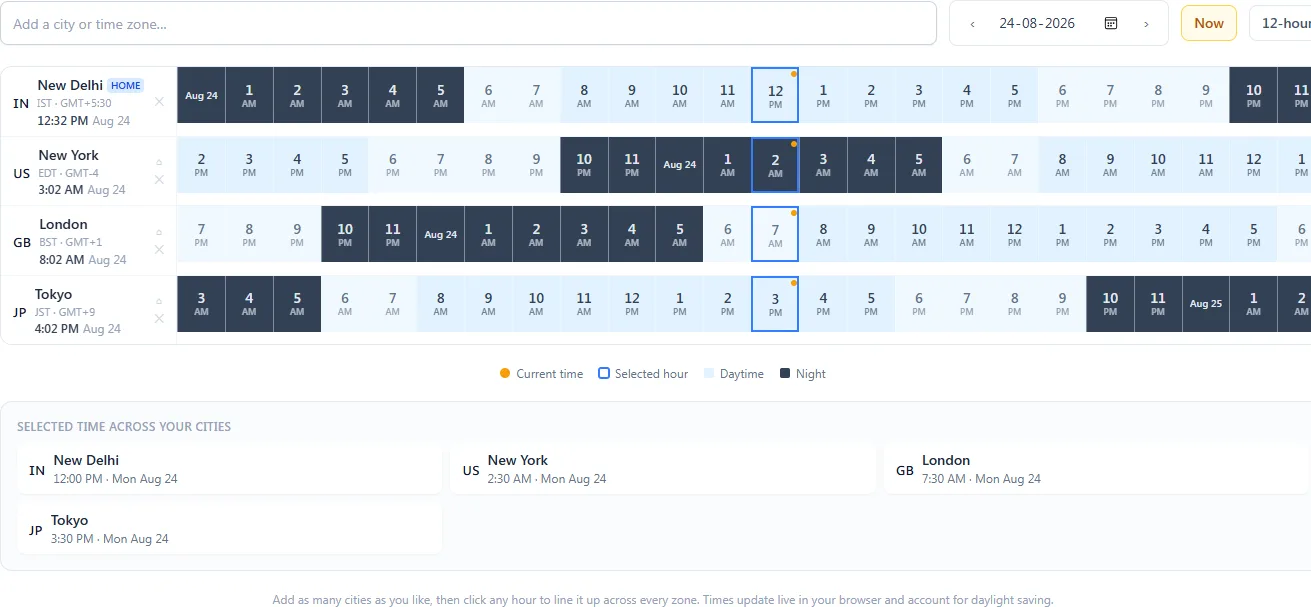
Plan for real people
A mathematically correct conversion can still schedule someone at an unreasonable hour. Add the participant cities, compare normal working windows, and rotate recurring meeting times when one region would otherwise carry the inconvenience every week.
- Show the organizer's zone and each participant's local time.
- Check whether the meeting crosses midnight locally.
- Review the conversion again after a daylight saving transition.
- Send a calendar invite containing an absolute event time.
Write time unambiguously
Prefer '24 August 2026, 3:00 PM in New Delhi (IST)' over 'tomorrow at 3.' For technical systems, store the event as a UTC timestamp and retain the intended IANA time zone for display and recurrence rules.
Try the related tools
Apply the steps from this guide directly in your browser.
Frequently asked questions
Why does the time difference between two cities change?
They may start or end daylight saving time on different dates, or only one location may observe it.
Is a time-zone abbreviation enough?
No. Abbreviations can be ambiguous and do not carry full historical or daylight saving rules. Use a city and date.
Can a converted time fall on another date?
Yes. Large offsets and times near midnight commonly move the destination to the previous or next calendar day.